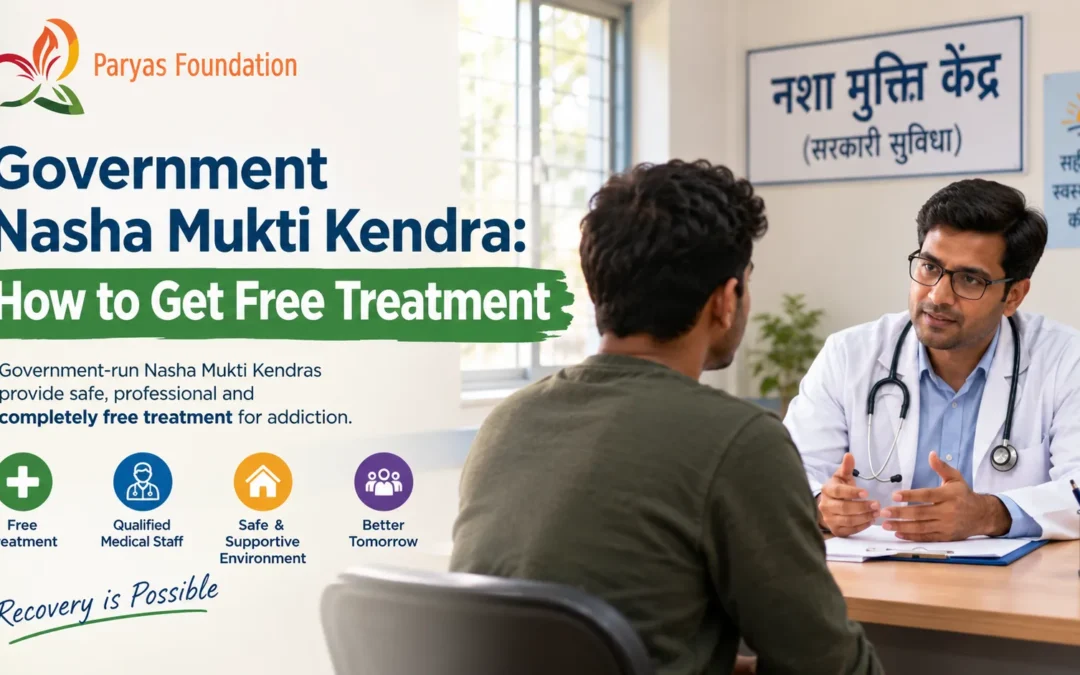
When money is tight, a government nasha mukti kendra is often the first place families look. That is a sensible instinct. This guide explains what public services offer, who can use them, what to carry, and where the limits are. Nobody should promise you more than that, and we won’t.
In this guide
- What a government nasha mukti kendra offers
- Is it really free?
- Who is eligible
- Documents to carry
- How to apply, step by step
- OOAT clinics in Punjab
- Government vs private
- Official sources
- FAQs
What a Government Nasha Mukti Kendra Offers
“Government” covers a few different things.
- Government hospitals – Psychiatry departments in district and medical-college hospitals treat alcohol and drug dependence, including withdrawal management.
- District de-addiction centres – These facilities are managed by the state and frequently connected to a civil hospital. Some offer inpatient beds, counselling and follow-up.
- OOAT clinics (Punjab) – Outpatient Opioid Assisted Treatment clinics give daily medicine for opioid dependence, with counselling. The patient takes the dose at the clinic.
- NGO centres funded by the government – Under the Ministry of Social Justice and Empowerment’s National Action Plan for Drug Demand Reduction (NAPDDR), the government funds Integrated Rehabilitation Centres for Addicts, which are run by NGOs. Addiction treatment services in government hospitals established by AIIMS, New Delhi, are also listed in the system.
Services differ a lot from one place to another. A small centre may offer only outpatient care. A larger hospital may admit people.
Is it Really Free?
Often, but not always, and “free” can mean different things.
In Punjab, the state has said that medicine at government OOAT clinics is free. It has also announced free treatment for patients from poor families at state-run de-addiction centres. Those announcements were made over several years, so ask what applies today.
A true nasha mukti kendra free of cost usually means treatment and medicine are free. Small things may still cost you: a registration slip, tests done outside, travel, or food for the attendant. Ask before you go.
The reverse is also worth knowing. At private OOAT centres in Punjab, patients are reported to pay for the tablets, with prices of Rs 25 to Rs 40 per tablet mentioned in a recent news report. That is a very different bill.
Real medical care is still provided by a free Nasha Mukti Kendra. It just comes with real limits, which brings us to the next point.
Who is Eligible
There is no one national eligibility test. Each centre sets its own rules, but these points hold in most places:
- Age. Most centres treat adults. Teenagers are usually referred to specialist or child-focused services.
- Type of substance. OOAT clinics are designed to treat opioid dependence (e.g., heroin, chitta, or opium products). For alcohol, go to the hospital’s psychiatry department or the district de-addiction centre.
- Free treatment. Some free schemes are aimed at poor families, for example those with a BPL card. In Punjab, doctors have also been given discretion to treat poor patients without one. This can change, so ask.
- Willingness. A person usually must agree to be treated. A doctor can advise how to approach someone who refuses.
- Medical condition. Someone in danger, with seizures or severe confusion, should go to a hospital emergency department straight away.
Documents to Carry
Bring what you have. Not having everything is not a reason to stay away.
- A photo ID, usually Aadhaar. OOAT clinics in Punjab have given patients a unique ID linked to Aadhaar, which helps them collect medicine from any functional clinic.
- A BPL card or income certificate, if you want to claim free treatment on that basis
- Past prescriptions, test reports or hospital papers
- A list of current medicines
- Contact details of a family member
Ask the centre by phone what it needs. It may differ from this list.
How to Apply, Step by Step
There is no online form for most services. The process is usually simple.
- Call 14446 first – This is the Ministry of Social Justice and Empowerment’s toll-free helpline for primary counselling and referral. When you call the National Narcotics Helpline (1933) regarding addiction, the call is routed to 14446.🔗 Our guide to the nasha mukti helpline number explains each one.
- Pick a centre near you – Use the helpline’s referral, the district civil hospital, or your Civil Surgeon’s office.
- Go for an assessment – Bring the person if you can. A doctor asks about the substance, how long it has been used and what health problems exist.
- Register – The staff note details and may issue an ID or a registration slip.
- Follow the plan – That might be daily outpatient visits, a bed in a ward, or counselling sessions.
- Keep going back – Follow-up matters as much as the first visit.
If you want help working out which door to knock on, 🔗 contact us and we will point you towards the right service, whether or not it is ours.
OOAT Clinics in Punjab
Punjab began its OOAT programme in 2017. A news report in October 2026 said the state has set up 547 government OOAT clinics, alongside 177 licensed private centres.
Here is how they work:
- The patient takes the medicine in front of the doctor at the clinic. It is not sent home.
- Counselling is part of the visit.
- A central registry tracks patients, so someone can collect medicine from another clinic if needed.
- It suits people who want to keep working and living at home.
OOAT treats opioid dependence. It is not for alcohol. It also works best with counselling and family support, not as medicine alone.
Because the numbers and rules change, ask your Civil Surgeon’s office or the Punjab Health Department for the nearest working clinic. For local options, see our page on 🔗 nasha mukti kendra in Punjab.
Government vs Private
Neither is always better. It depends on what you need.
Government centres cost less or nothing, and they are linked to hospitals for emergencies. The trade-offs can include waiting lists, limited beds, crowded wards and short counselling time.
Private centres often offer more comfort, more counselling time and quicker admission. They also cost more, and quality varies. Always check registration and ask for costs in writing.
Read our full comparison of 🔗 government vs private rehab before you decide.
FAQs
1. What Is the Government Scheme for Prevention of Drug Addiction?
India's National Action Plan for Drug Demand Reduction (NAPDDR), implemented by the Ministry of Social Justice and Empowerment, supports drug prevention, awareness, counselling, treatment and rehabilitation. The Ministry of Health and Family Welfare also runs the Drug De-addiction Programme (DDAP), which supports treatment services through government health facilities.
2. Is Rehab Free in India?
Yes, free or subsidised rehabilitation may be available through government hospitals, publicly funded programmes and eligible charitable centres. Availability, eligibility requirements and services vary by location and facility. Contact the centre directly to confirm costs and admission requirements.
3. Can I Get Admitted Without a BPL Card?
Admission without a Below Poverty Line (BPL) card depends on the facility and the scheme being used. Some centres may accept other income or identity documents, while others have specific eligibility rules. Contact the centre or your local health department to confirm which documents are accepted.
4. Do I Need an Aadhaar Card for De-Addiction Treatment?
Aadhaar may be requested for registration or programme-related documentation, but requirements vary by facility and scheme. If you do not have an Aadhaar card, contact the centre to ask whether alternative identity documents are accepted.
5. Is OOAT Treatment Suitable for Alcohol Addiction?
No. Outpatient Opioid Assisted Treatment (OOAT) is intended for opioid dependence, not alcohol addiction. For alcohol-related problems, consult a qualified doctor, hospital psychiatry department or de-addiction centre for an appropriate assessment and treatment plan. If someone has been drinking heavily for a long time, medical advice is important before stopping suddenly because alcohol withdrawal can be dangerous.