Choosing a Govt Rehabilitation Centre or a Private One

Choosing a Govt Rehabilitation Centre or a Private One

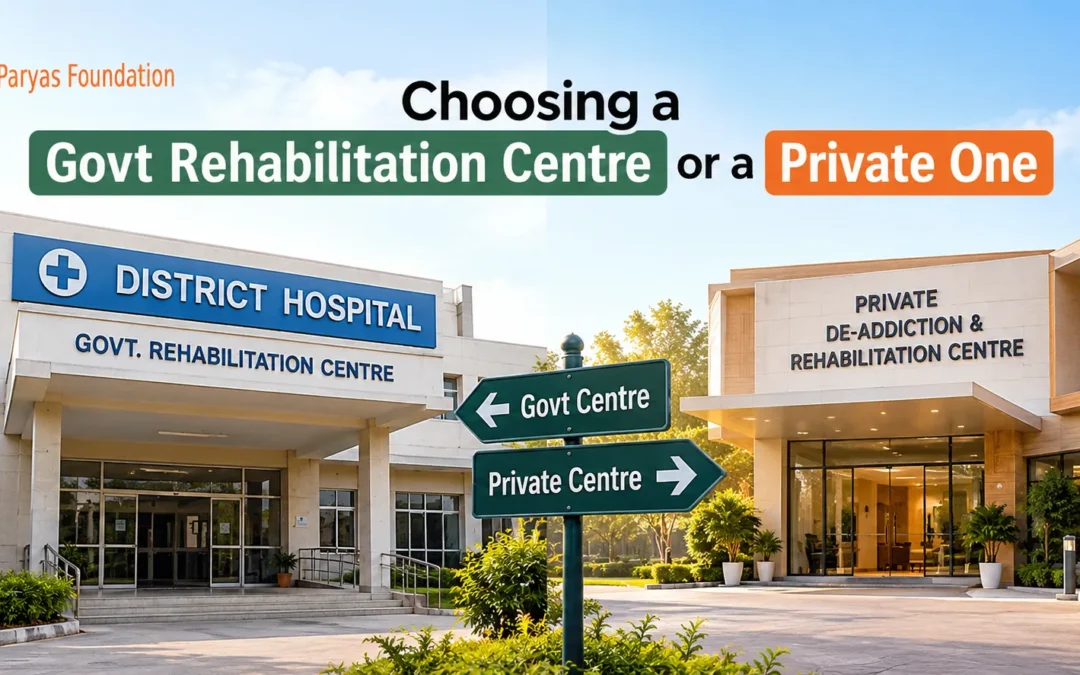
    When a family is ready to act, the next question that usually comes up is “Government or private?”. “It depends” is the truthful response to this reasonable question. This guide compares a govt rehabilitation centre with a private one, side by side, so you can decide with clear eyes.

    In this guide

    1. What a govt rehabilitation centre offers
    2. Side-by-side comparison
    3. Pros and cons
    4. Who each option suits
    5. How to find a centre near you
    6. Checking a private centre
    7. FAQs

    What a Govt Rehabilitation Centre Offers

    In Punjab, public services come in a few forms: district and medical-college hospitals, state-run de-addiction and rehabilitation centres, and outpatient opioid clinics (OOAT). Some NGO-run rehabilitation centres also receive funding under the Ministry of Social Justice and Empowerment’s National Action Plan for Drug Demand Reduction.

    Detox and rehabilitation are two different stages. Detox clears the substance from the body under medical care. Rehabilitation is the longer work of counselling and rebuilding routines. Punjab’s 2011 regulations, as quoted by The Quint, say a person should have detox at a recognised centre before being admitted to a rehabilitation centre. Ask which stage a centre provides.

    On cost, Punjab Health Department letters from 2018 set user charges at Rs 200 a day at government de-addiction centres and Rs 50 a day at government rehabilitation centres. Yellow or blue card holders and those living below the poverty level were to receive treatment at no cost.  A later 2018 order said treatment would be at no charge for everyone at government and Indian Red Cross centres. These orders are several years old, so confirm what applies today. Our guide to a 🔗 free nasha mukti kendra explains how to check.

    Side-by-Side Comparison

    These are general patterns, not rules. Individual centres differ.

    Government centre Private centre
    Cost Low, and at no charge where you are eligible Paid. Fees vary a lot between centres, so ask for a written, itemised quote 
    Admission Can involve waiting, and beds may be limited Often quicker
    Medical cover Linked to a hospital for emergencies Varies. Find out if a doctor is available or on call. 
    Counselling time Staff may be stretched across many patients Can be more personal, depending on staffing
    Comfort and privacy Basic, often shared wards Wider choice, including private rooms
    Oversight Run by the state Must be registered. Quality varies, so check
    Family involvement Varies Varies. Ask before admission

    Pros and Cons

    Government centres

    Pros

    • Much lower cost, and sometimes none
    • Connected to hospital services if something goes wrong
    • A suitable fit when the primary obstacle is financial 

    Cons

    • Beds and appointments can be limited
    • Wards can be crowded, with less individual attention
    • Facilities differ by district, and some centres may be inactive, so call ahead

    Private centres

    Pros

    • Faster admission in many cases
    • More options for rooms, schedules, and duration of programs 
    • Can offer more counselling time and family sessions

    Cons

    • Higher cost, and extra charges for medicines or tests
    • Uneven quality. Punjab news reports over the years have described unregistered centres and poor practice at some facilities, though many run properly
    • Harder to compare, because every centre prices differently

    For a closer look at pricing, see our breakdown of the 🔗 cost of rehab in Punjab.

    Who Each Option Suits

    A government centre may suit you if cost is the biggest concern, the person is willing to wait for a bed, or you want care linked to a hospital. An outpatient opioid clinic can work well for someone who needs to keep working and can attend daily.

    A private centre may suit you if you need admission quickly, want more privacy, or need a longer, more structured stay and can afford it.

    A mix can work too. Some families use a government service for detox, then move to a private or NGO programme for rehabilitation, or the other way round. Ask the treating doctor what makes sense.

    How to Find a Centre Near You

    Searching for a government de-addiction centre near me online can show outdated listings. These steps are more reliable:

    • Ask the Civil Surgeon’s office or the district hospital’s psychiatry department for the nearest working centre.
    • For a referral, contact the national de-addiction hotline.  
    • Phone the centre before you travel. Verify that it is open, has beds, and accepts new patients. 

    If you are near Chandigarh, our page on a 🔗 nasha mukti kendra in Mohali lists what to ask locally.

    Checking a Private Centre

    If you are looking at a private nasha mukti kendra, check these before you pay anything:

    • Registration and licence. Ask to see them.
    • Doctors. Who is on site, and who handles an emergency at night?
    • Assessment. A responsible centre assesses the person before quoting a plan.
    • Total cost, in writing, with extras itemised and a receipt for every payment.
    • Treatment of patients. Visit in person if you can. Ask about visiting rules, phone access and consent.
    • No guarantees. Any center that offers a cure should be avoided. 


    FAQs

    1. What is the work of a rehabilitation centre?

    A rehabilitation centre provides structured treatment and support to help people recover from physical injuries, surgeries, mental health conditions, or substance use disorders. Its work may include medical care, therapy, counselling, physical rehabilitation, and aftercare to improve daily functioning and support long-term recovery and independence.

    2. Do you pay for rehabilitation?

    Rehabilitation may be free, subsidised, or paid, depending on the type of treatment, facility, and available financial support. In India, government hospitals and recognised de-addiction programmes may provide free or low-cost services, while private centres generally charge fees. Before admission, ask about the total cost, available government assistance, insurance coverage, and any additional charges.

    3. How do I find a government de-addiction centre near me?

    Contact your nearest government district hospital and ask for its psychiatry or de-addiction department. You can also approach the District Social Welfare Office or Civil Surgeon’s office for information about government-supported treatment facilities. Ask for a referral and call the centre beforehand to confirm its services, admission process, availability, and eligibility requirements.

    4. What should I ask before choosing a private Nasha Mukti Kendra?

    Before choosing a private Nasha Mukti Kendra, ask about its registration, qualified doctors, medical supervision, staff credentials, emergency arrangements, treatment methods, and family involvement. Confirm the complete treatment cost, including medicines and additional services, and ask what aftercare and relapse-prevention support are provided. Request clear written details and avoid centres that promise guaranteed recovery or cannot explain their treatment process.
    Which Nasha Mukti Helpline Number Should You Call?

    Which Nasha Mukti Helpline Number Should You Call?

    If you are here at 2 am with a shaking hand on your phone, take a breath. You have already done the hardest part, which is deciding to look for help. Whether you are worried about yourself, a husband, a son or a friend, you don’t need to have the whole situation figured out before you call. Start with the table below, pick the line that fits, and let the rest of this page wait until you are ready for it. 

    Verified numbers (checked 22 October 2026)

    Number Who runs it Call it for
    9988199333 Paryas Foundation Counselling and referral for alcohol and drug problems
    1933 Narcotics Control Bureau (MANAS) Reporting drug dealing. Addiction calls are passed on to the line above
    14416 or 1-800-891-4416 Ministry of Health (Tele-MANAS) Free mental health support, day and night, in about 20 languages including Punjabi
    112 National emergency number Medical emergencies and immediate danger

    We checked these against government sources: the Ministry’s helpline statement, the PIB factsheet on MANAS and the Tele-MANAS programme pages. Numbers can change, so if one doesn’t connect, try another from the table.

    Selecting the Appropriate Nasha Mukti Helpline Number for Your Circumstance 

    An individual is ready to quit drinking or using drugs.  Use the national de-addiction helpline, the first row of the table. It offers first counselling and points you to a service. This is the first nasha mukti number for the majority of households.

    The person is anxious, low or not coping. The mental health helpline in the third row is free, runs round the clock, and is not only for addiction. Tele-MANAS also answers in Punjabi.

    You want to report someone selling drugs. Use the narcotics reporting line. It is separate from treatment, so don’t call it for counselling.

    It is an emergency. Go to the closest hospital or use the emergency phone. Don’t wait for a callback if the person has had a seizure, is unconscious, is very confused, may have overdosed, or talks about harming themselves.

    When Is It Time to Call?

    You don’t have to wait for a catastrophe. If you see any of them, give a call :

    • They can’t cut down, even after promising to
    • They shake, sweat or feel sick without the substance
    • Work, studies or money are getting worse
    • They hide it, or lie about how much
    • They have become angry, withdrawn or unpredictable
    • You are scared, tired or unsure what to do next

    You can choose to call someone else or yourself. Many callers are parents, wives and siblings.

    What to Say When You Call

    Most people freeze on the first call. That is normal. You don’t have to prepare a speech. Here is a simple way to begin:

    “”I haven’t seen my partner, spouse, child, brother, sister, or friend using drugs or alcohol in a long time.I’m concerned and would like to know what resources are available in your community.”

    Then answer what you can. It helps to have these details ready:

    • The substance. Tablets, alcohol, heroin or chitta, or multiple 
    • How long and how much. A rough idea is enough
    • The last time they used it. This matters if withdrawal could start
    • Health problems and medicines. Anything the person takes regularly
    • Your town or district. So the counsellor can suggest a nearby service

    If you don’t know something, say “I’m not sure.” That is a perfectly good answer. It is also fine to say you are scared or don’t know where to start. On a de-addiction helpline, the person on the other end has heard it before. 

    Keep a pen nearby. Before you hang up, write down the name of any service they suggest, its address and its phone number, and ask what to do first. If you want privacy, ask how your call is handled before you share personal details.

    What to Expect on the Call

    You will probably be asked a few simple things:

    • Whether the person has tried to stop before, and what happened
    • Whether the person is willing to get help
    • Whether there is any medical risk right now

    A helpline can listen, give first advice and point you to a service. It cannot admit anyone by phone or give a prescription. Admission and medical care happen at a hospital or centre.

    We could not confirm the operating hours of the national de-addiction helpline. If nobody answers, try again at a different time.

    If Nobody Picks Up

    Don’t give up for the day. Here is what to do:

    1. Try again after a short gap.
    2. Use the round-the-clock mental health helpline from the table for support in the meantime.
    3. Visit the psychiatry department of your district hospital. Our guide to free and government treatment explains the options.
    4. If anyone is in danger, use the emergency number.

    Safety First: Stopping Suddenly Can Be Dangerous

    This matters, so we’ll say it plainly. If someone drinks heavily every day, or uses sleeping pills or certain other drugs, stopping overnight can cause tremors, confusion, hallucinations and seizures. Please don’t try to “lock them in a room until they quit.” A doctor should assess the person first.

    How to Talk to the Person

    The call is often easier than the conversation at home. A few things that help:

    • Pick the moment. Choose a calm time. Not during a fight, and not when the person is drunk or high.
    • Speak about yourself. “You’re ruining this family” is not as appropriate as “I’m scared when you don’t come home.” 
    • Skip the shame. Blame makes people hide more.
    • Offer one small step. “Would you mind going to the doctor with me?” is easier than “you need rehab.”
    • Don’t give up after one no. Many people refuse at first. Keep the door open.

    What to Do After the Call

    A phone call is the first step. The next ones usually look like this:

    1. Get an assessment. A doctor should see the person, especially after heavy drinking.
    2. Choose a service. Government options can be free or low cost. A private centre costs more, so ask for the total in writing.
    3. Check registration and staff. Ask who the doctors are and what the emergency plan is.
    4. Plan for follow-up. Recovery continues long after the first week.

    If you’re near Mohali, see our page on a nasha mukti kendra in Mohali.

    Looking for a Nasha Mukti Kendra Contact Number?

    Helplines point you to services. A centre’s own number is what books an assessment or a visit. Before you call any centre, ask:

    • Where is it, and can family visit?
    • Who is the doctor, and what happens in an emergency?
    • What is the total cost, in writing?
    • What support is there after discharge?

    You can contact Paryas Foundation to ask about services, location and admission. Confirm everything directly before you travel.

    Four Myths About Calling a Helpline

    “They will send the police.” The addiction counselling line is for support and referral. Reporting drug dealing is a separate line. Ask about privacy when you call.

    “It’s only for people who are ready to quit.” Family members can call first, even if the person refuses.

    “It costs money.” The Ministry describes the national de-addiction helpline as toll-free, and the mental health helpline is free.

    “One call will fix it.” It won’t, and nobody should say it will. The call gets you to the next step.

    FAQs

    1. What Is the English Name of Nasha Mukti Kendra?

    The English name for Nasha Mukti Kendra is usually "de-addiction centre" or "rehabilitation centre." These terms refer to facilities that help people recover from drug or alcohol dependence through treatment, counselling and support.

    2. What Is the New Name for Substance Abuse?

    The clinical term commonly used instead of "substance abuse" is "substance use disorder" (SUD). It describes a pattern of alcohol or drug use that causes significant health, social or daily-life problems. The term helps healthcare professionals describe the condition without using stigmatising language.

    3. Is the Helpline Open 24 Hours?

    Some addiction support services operate 24 hours a day, but availability depends on the organisation. The operating hours of the helpline number 9988199333 could not be confirmed. Call the number directly to check its availability. If someone is experiencing a medical emergency, contact local emergency services or go to the nearest hospital.

    4. How Can You Help Someone with Drug Addiction?

    Talk to the person calmly when they are not under the influence, listen without blaming them and encourage professional help. A doctor or qualified de-addiction centre can assess their needs and recommend suitable treatment, which may include counselling, medically supervised withdrawal, medication or support groups. Avoid forcing sudden withdrawal without medical advice, as it can be dangerous with certain substances.

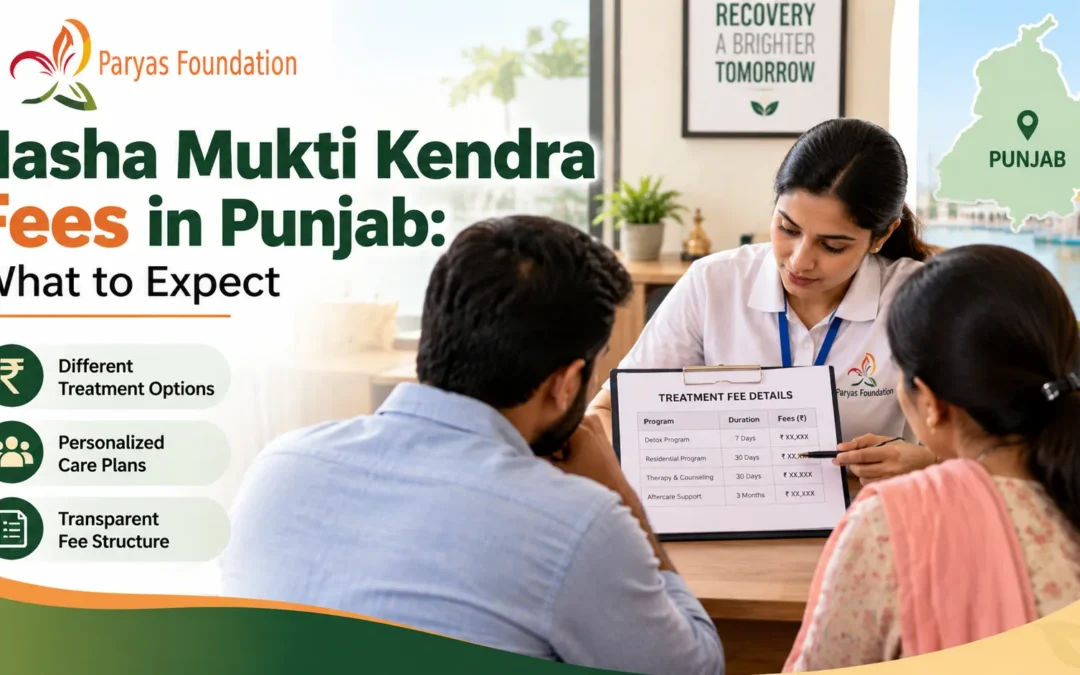
    Nasha Mukti Kendra Fees in Punjab: What to Expect

    Nasha Mukti Kendra Fees in Punjab: What to Expect

    Families usually ask about money in the first phone call, and then feel awkward about it. Don’t. Cost is a fair question, and a good centre answers it plainly.

    This guide covers nasha mukti kendra fees and the cost of rehab in Punjab. It also says where the numbers come from, because a price range is only useful if you know how old it is.

    In this guide

    1. What the published numbers say
    2. What changes the cost
    3. What is included, and what often isn’t
    4. Does insurance help?
    5. Questions to ask before you pay
    6. FAQs

    Nasha Mukti Kendra Fees in Punjab: How Much Will You Pay?

    It depends on where you go. In Punjab, the cost differs sharply between a government centre, a government OOAT clinic and a private rehab. What to anticipate from each is as follows.

    If you choose

    What you may pay

    Good to know

    Government de-addiction centre Free or very low cost. Punjab’s 2018 rules listed Rs 200 a day (medicine, food and bed included) and made treatment free for poor families and, in a later order, for everyone at government centres Beds and waiting times can be limited. Confirm current rules with your Civil Surgeon’s office
    Government rehabilitation centre Rs 50 a day under the 2018 rules, or free Usually follows detox. Ask whether a bed is available
    Government OOAT clinic Medicine free For opioid dependence only, not alcohol
    Private OOAT centre Rs 25 to Rs 40 per tablet (ThePrint, October 2026) Daily tablets add up over months
    Private rehab centre Older reports put it at about Rs 8,000 to Rs 15,000 a month, and up to Rs 30,000 Current prices are likely higher. Ask for an itemised quote

    Plan for the whole programme, not one month. Detox may take one or two weeks, and rehabilitation often runs for several months. A “monthly fee” can look small until you multiply it.

    Expect extras. Medicines, tests, doctor visits and aftercare are sometimes billed separately. We cover this in the next section.

    Use the table as a check, not a quote. The government figures come from 2018 orders and the private figures from older news reports, so rules and prices may have changed. If a centre quotes far below this range, ask what is left out. Ask what you are getting for it if the quote is much higher. 

    Compare three. Get a written, itemised quote from at least three places. Our guide to a 🔗 Government Nasha Mukti Kendra shows how to check government options first.

    What Changes the Cost

    Two people at the same centre can pay very different amounts. The main reasons:

    • Type of care. Outpatient care costs less than a residential stay.
    • Length of stay. During detox, a week or two may go by. Rehabilitation and counselling can run for months.
    • Substance and severity. Multiple drug use or heavy alcohol consumption may require more specialized medical attention.
    • Medical needs. Other illnesses, such as liver problems, infections or depression, add tests and medicines.
    • Room type. Shared dormitory, double room or single room.
    • Staffing. Full-time doctors, psychiatrists and trained counsellors cost more than a small team.
    • Location. A centre in Mohali or near Chandigarh may price differently from one in a smaller town. See our page on a  nasha mukti kendra in Mohali.

    What is Included, and What Often isn’t

    Always ask for the quote itemised. Here is a usual split, but check each item.

    Often included: room, meals, basic nursing care, daily monitoring, and group or individual counselling.

    Sometimes extra:

    • Doctor or psychiatrist visits
    • Blood tests, scans and ECGs
    • Medicines, especially for withdrawal
    • Hospital transfer in an emergency
    • Family counselling sessions
    • Aftercare and follow-up visits
    • Registration or admission fee
    • A refundable deposit

    A low monthly figure can grow quickly if medicine and tests are billed separately. Ask for the likely total for the whole programme, not only the first month.

    Does Insurance Help?

    Sometimes, but do not assume.

    The IRDAI in a circular on August, 2018 has advised insurers that they need to abide by the Mental Healthcare Act, 2017, which says in Section 21(4) that insurers have to cover mental illness on the same basis as physical illness. The Act defines alcohol and drug related conditions as mental illnesses.

    However, in practice, addiction tends to be left out of policies. As per the standardisation circular notes issued by IRDAI in 2020, the regulator still has a clause that permits insurers to exclude “alcoholism, drug or substance abuse or any addictive condition.” In 2024, a survey of 459 policies revealed that the majority – 87% – included some policy addressing alcohol or substance use.

    Check your policy for the provisions, contact your insurer and inquire in writing if detox, inpatient rehab, and counselling is covered. Never make a deposit, assuming that the claim will be accepted.

    Official sources: India Code on Mental Healthcare Act, 2017 and IRDAI‘s page on Mental health cover. Always check the latest revision of each prior to using it.


    FAQs

    1. What Are the Different Types of Rehab?

    Rehabilitation includes different forms of care. Physical, occupational and cognitive rehabilitation help people regain physical abilities, thinking skills or independence in daily activities. Substance use rehabilitation focuses on treating drug or alcohol dependence through counselling, medical care and ongoing support. Mental health rehabilitation helps people manage symptoms and improve daily functioning.

    2. What Happens in Rehab in India?

    Rehabilitation in India typically begins with an assessment of a person's health, substance use history and treatment needs. Depending on the condition, the programme may include medical care, supervised withdrawal, individual or group counselling, behavioural therapy and relapse-prevention planning. Treatment plans and services vary between centres.

    3. How Long Is Rehab in India?

    Rehabilitation in India may last a few weeks to several months, depending on the person's condition, treatment goals and progress. Some programmes last 14 to 30 days, while others continue for 60 to 90 days or longer. A qualified treatment professional can recommend an appropriate duration based on individual needs.

    4. Why Do Some Rehab Centres Charge Much More Than Others?

    Rehabilitation costs vary depending on the centre's location, accommodation, staff qualifications, medical supervision, treatment methods and available facilities. Before choosing a centre, request a detailed breakdown of fees, including medication, consultations, therapy sessions, accommodation and any additional charges, so you can compare services accurately.

    Government Nasha Mukti Kendra: How to Get Free Treatment

    Government Nasha Mukti Kendra: How to Get Free Treatment

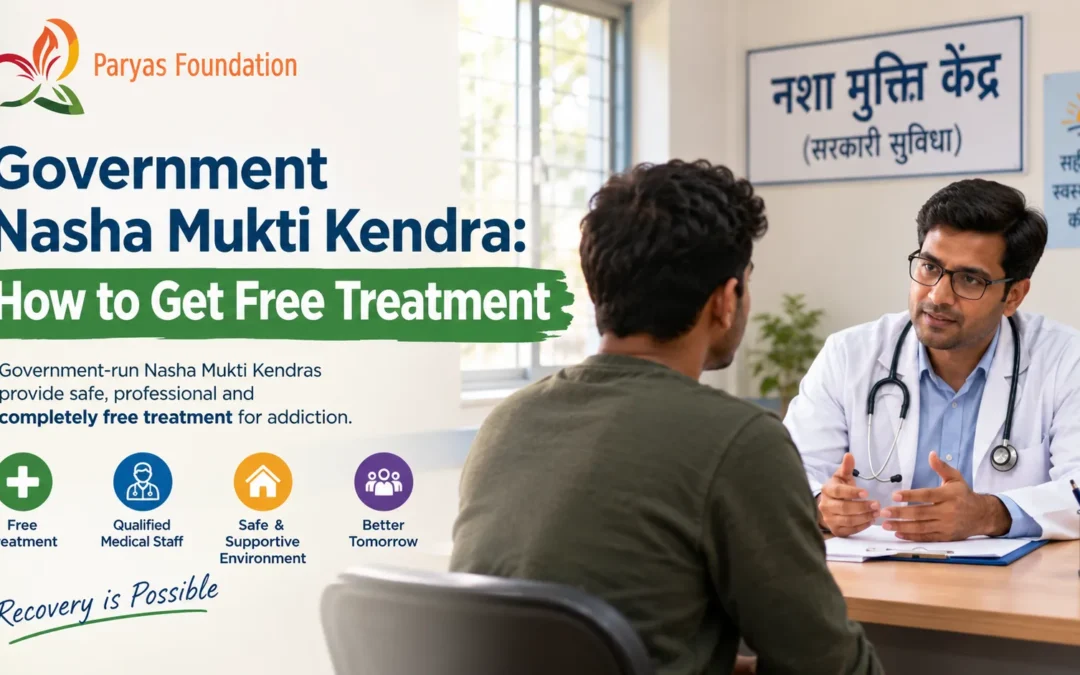
    When money is tight, a government nasha mukti kendra is often the first place families look. That is a sensible instinct. This guide explains what public services offer, who can use them, what to carry, and where the limits are. Nobody should promise you more than that, and we won’t.

    In this guide

    1. What a government nasha mukti kendra offers
    2. Is it really free?
    3. Who is eligible
    4. Documents to carry
    5. How to apply, step by step
    6. OOAT clinics in Punjab
    7. Government vs private
    8. Official sources
    9. FAQs

    What a Government Nasha Mukti Kendra Offers

    “Government” covers a few different things.

    • Government hospitals – Psychiatry departments in district and medical-college hospitals treat alcohol and drug dependence, including withdrawal management.
    • District de-addiction centres – These facilities are managed by the state and frequently connected to a civil hospital. Some offer inpatient beds, counselling and follow-up.
    • OOAT clinics (Punjab) – Outpatient Opioid Assisted Treatment clinics give daily medicine for opioid dependence, with counselling. The patient takes the dose at the clinic.
    • NGO centres funded by the government – Under the Ministry of Social Justice and Empowerment’s National Action Plan for Drug Demand Reduction (NAPDDR), the government funds Integrated Rehabilitation Centres for Addicts, which are run by NGOs. Addiction treatment services in government hospitals established by AIIMS, New Delhi, are also listed in the system.

    Services differ a lot from one place to another. A small centre may offer only outpatient care. A larger hospital may admit people.

    Is it Really Free?

    Often, but not always, and “free” can mean different things.

    In Punjab, the state has said that medicine at government OOAT clinics is free. It has also announced free treatment for patients from poor families at state-run de-addiction centres. Those announcements were made over several years, so ask what applies today.

    A true nasha mukti kendra free of cost usually means treatment and medicine are free. Small things may still cost you: a registration slip, tests done outside, travel, or food for the attendant. Ask before you go.

    The reverse is also worth knowing. At private OOAT centres in Punjab, patients are reported to pay for the tablets, with prices of Rs 25 to Rs 40 per tablet mentioned in a recent news report. That is a very different bill.

    Real medical care is still provided by a free Nasha Mukti Kendra. It just comes with real limits, which brings us to the next point.

    Who is Eligible

    There is no one national eligibility test. Each centre sets its own rules, but these points hold in most places:

    • Age. Most centres treat adults. Teenagers are usually referred to specialist or child-focused services.
    • Type of substance. OOAT clinics are designed to treat opioid dependence (e.g., heroin, chitta, or opium products). For alcohol, go to the hospital’s psychiatry department or the district de-addiction centre.
    • Free treatment. Some free schemes are aimed at poor families, for example those with a BPL card. In Punjab, doctors have also been given discretion to treat poor patients without one. This can change, so ask.
    • Willingness. A person usually must agree to be treated. A doctor can advise how to approach someone who refuses.
    • Medical condition. Someone in danger, with seizures or severe confusion, should go to a hospital emergency department straight away.

    Documents to Carry

    Bring what you have. Not having everything is not a reason to stay away.

    • A photo ID, usually Aadhaar. OOAT clinics in Punjab have given patients a unique ID linked to Aadhaar, which helps them collect medicine from any functional clinic.
    • A BPL card or income certificate, if you want to claim free treatment on that basis
    • Past prescriptions, test reports or hospital papers
    • A list of current medicines
    • Contact details of a family member

    Ask the centre by phone what it needs. It may differ from this list.

    How to Apply, Step by Step

    There is no online form for most services. The process is usually simple.

    1. Call 14446 first – This is the Ministry of Social Justice and Empowerment’s toll-free helpline for primary counselling and referral. When you call the National Narcotics Helpline (1933) regarding addiction, the call is routed to 14446.🔗 Our guide to the nasha mukti helpline number explains each one.
    2. Pick a centre near you – Use the helpline’s referral, the district civil hospital, or your Civil Surgeon’s office.
    3. Go for an assessment – Bring the person if you can. A doctor asks about the substance, how long it has been used and what health problems exist.
    4. Register – The staff note details and may issue an ID or a registration slip.
    5. Follow the plan – That might be daily outpatient visits, a bed in a ward, or counselling sessions.
    6. Keep going back – Follow-up matters as much as the first visit.

    If you want help working out which door to knock on, 🔗 contact us and we will point you towards the right service, whether or not it is ours.

    OOAT Clinics in Punjab

    Punjab began its OOAT programme in 2017. A news report in October 2026 said the state has set up 547 government OOAT clinics, alongside 177 licensed private centres.

    Here is how they work:

    • The patient takes the medicine in front of the doctor at the clinic. It is not sent home.
    • Counselling is part of the visit.
    • A central registry tracks patients, so someone can collect medicine from another clinic if needed.
    • It suits people who want to keep working and living at home.

    OOAT treats opioid dependence. It is not for alcohol. It also works best with counselling and family support, not as medicine alone.

    Because the numbers and rules change, ask your Civil Surgeon’s office or the Punjab Health Department for the nearest working clinic. For local options, see our page on 🔗 nasha mukti kendra in Punjab.

    Government vs Private

    Neither is always better. It depends on what you need.

    Government centres cost less or nothing, and they are linked to hospitals for emergencies. The trade-offs can include waiting lists, limited beds, crowded wards and short counselling time.

    Private centres often offer more comfort, more counselling time and quicker admission. They also cost more, and quality varies. Always check registration and ask for costs in writing.

    Read our full comparison of 🔗 government vs private rehab before you decide.

    FAQs

    1. What Is the Government Scheme for Prevention of Drug Addiction?

    India's National Action Plan for Drug Demand Reduction (NAPDDR), implemented by the Ministry of Social Justice and Empowerment, supports drug prevention, awareness, counselling, treatment and rehabilitation. The Ministry of Health and Family Welfare also runs the Drug De-addiction Programme (DDAP), which supports treatment services through government health facilities.

    2. Is Rehab Free in India?

    Yes, free or subsidised rehabilitation may be available through government hospitals, publicly funded programmes and eligible charitable centres. Availability, eligibility requirements and services vary by location and facility. Contact the centre directly to confirm costs and admission requirements.

    3. Can I Get Admitted Without a BPL Card?

    Admission without a Below Poverty Line (BPL) card depends on the facility and the scheme being used. Some centres may accept other income or identity documents, while others have specific eligibility rules. Contact the centre or your local health department to confirm which documents are accepted.

    4. Do I Need an Aadhaar Card for De-Addiction Treatment?

    Aadhaar may be requested for registration or programme-related documentation, but requirements vary by facility and scheme. If you do not have an Aadhaar card, contact the centre to ask whether alternative identity documents are accepted.

    5. Is OOAT Treatment Suitable for Alcohol Addiction?

    No. Outpatient Opioid Assisted Treatment (OOAT) is intended for opioid dependence, not alcohol addiction. For alcohol-related problems, consult a qualified doctor, hospital psychiatry department or de-addiction centre for an appropriate assessment and treatment plan. If someone has been drinking heavily for a long time, medical advice is important before stopping suddenly because alcohol withdrawal can be dangerous.

    Nasha Mukti Explained: Treatment Steps & Recovery

    Nasha Mukti Explained: Treatment Steps & Recovery

    Most families hear the words nasha mukti for the first time in the worst week of their year. A son comes home unconscious. A husband shakes at 6 am until he finds a bottle. Someone finally says, “We need help.”

    This guide is for that moment. It walks through the whole nasha mukti process in simple language, so you know what is coming before you reach a centre.

    In this guide

    1. What nasha mukti means
    2. Signs it is time to get help
    3. The nasha mukti process, stage by stage
    4. Residential or outpatient care
    5. Choosing where to go
    6. How families can help
    7. FAQs

    What Nasha Mukti means

    “Nasha” covers alcohol, opioids, cannabis, sleeping pills, injectables and more. “Mukti” means freedom. Doctors call the condition substance use disorder.

    That name matters. It says this is a health problem. The brain changes with repeated use, and craving becomes strong enough to override good intentions. Weak character is not the cause.

    It is also very common here. The national survey done by AIIMS for the Ministry of Social Justice and Empowerment in 2019 estimated that about 16 crore Indians aged 10 to 75 used alcohol, and about 2.26 crore used opioids. The numbers are a few years old, but they tell you something simple. It’s not just your family.

    Signs it is time to get help

    You do not need to wait for a disaster. Talk to a doctor if you see any of these:

    • They promise to cut down and cannot
    • Without it, their hands tremble, they perspire, and they feel ill. 
    • Work, studies or money are slipping
    • They hide the habit or lie about it
    • They now need more than before for the same effect
    • They get angry or withdraw when you bring it up

    One or two is enough to ask a professional.

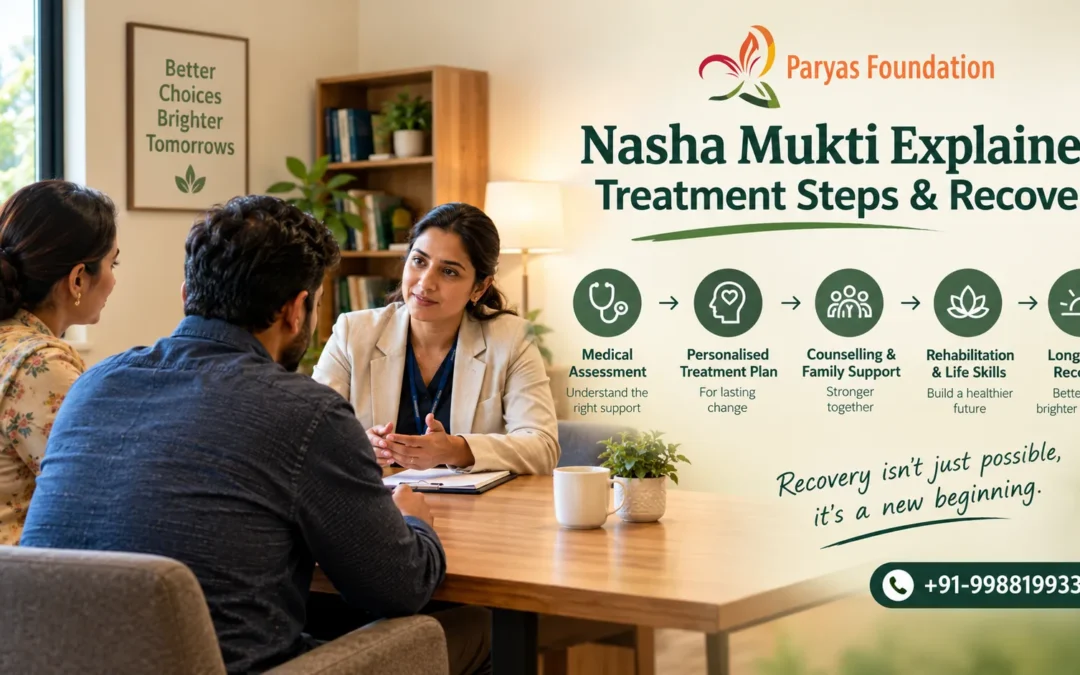
    The Nasha Mukti Process, Stage by Stage

    No two plans are the same. The substance, the number of years, and the person’s physical and mental health all change the plan. Still, most good programmes follow the same four stages, after an assessment.

    First, the assessment

    A doctor or counsellor asks what was used, how much, for how long, and what happened when the person tried to quit. They also ask about other illnesses, low mood and anxiety. Blood tests are common.

    This step decides everything else, including whether the person needs a hospital, a residential stay or outpatient visits. A place that quotes a fixed price over the phone without asking any of this deserves a second look.

    Stage 1: Detox

    Detox means letting the body clear the substance. It is rough, and with some substances it is risky.

    Heavy daily drinking is the clearest case. Stopping overnight can cause tremors, a racing heart, vomiting, confusion and seizures. Withdrawal from sleeping pills can be dangerous in the same way. For a healthy adult, opioid withdrawal is rarely fatal, but it is an unpleasant experience marked by cramping, bodily pains, and intense cravings. That misery is exactly why many people go back to using.

    So detox should happen under medical watch. To make withdrawal safer, doctors monitor symptoms and occasionally prescribe medication. Some people can manage as outpatients. Others need a facility or hospital. Many people finish detox in a week or two, though it varies.

    One thing to remember. Detox clears the body, but it does not answer why the person started using. That comes next.

    Stage 2: Counselling

    A lot of permanent change takes place here.

    Typically counselling consists of group sessions, family sessions and one-to-one sessions. A counsellor assists the person to identify triggers, including work stress, an evening alone, some friends or a quarrel at home. They then practice what to do when the urge hits. There are several programmes that employ techniques such as cognitive behavioural therapy. Names are not necessary to remember. What is important is that the individual is acquiring skills.

    In some cases, treatment for depression, anxiety or old trauma is also required. Often the substance started as a way to cope. Recovery remains shaky with that root left untouched.

    Sometimes, long-term medications may be used as well. Both opiate cravings and alcohol cravings can be treated with medications. The only source of these should be a qualified doctor. They aren’t trading in one addiction for another. They provide the individual with a more solid platform on which to perform the counselling functions.

    Check out chitta nasha therapy if you’re worried about chitta. 

    Stage 3: Aftercare

    Leaving the centre is not the finish line. For many people, it is where the hardest part begins.

    Aftercare means follow-up visits, regular counselling, support groups such as Alcoholics Anonymous or Narcotics Anonymous, and help getting back to work or study. A good centre plans this before discharge.

    Home matters too. Try to keep the house free of alcohol, agree on daily routines, and learn to speak without blame.

    Stage 4: Relapse prevention

    There are those who slip at some time. It hurts doesn’t mean that it failed.

    A plan for relapsing is prepared beforehand.The individual and the counselor both recognize the dangerous circumstances and early warning indicators (e.g., irregular sleep schedules, missing appointments, irritability). They also determine who they are to call should they need to see their doctor again or not.

    If you slip, you want to quickly get back on track, and without shame. The more it’s hidden the more severe the problem gets. The sooner you tell someone, the smaller it is.

    Residential or outpatient care

    Both are real choices.

    When someone receives residential care, they remain at the facility. It suits heavy or long-term dependence, risky withdrawal, other health problems, or a home where the substance is always within reach. Distance from triggers gives the brain time to settle.

    Outpatient care means the person lives at home and attends appointments. It can work for milder cases or where the family is steady and supportive. It costs less and lets daily life continue, but it takes more self-discipline.

    Let the doctor’s assessment guide this, not convenience or price alone. For a closer look at money, see the cost of nasha mukti treatment.

    Choosing Where to go

    Whether you pick a government hospital or a private centre, the basic checks are the same.

    • Are doctors available, including at night?
    • What happens in an emergency?
    • Does the programme include counselling and family sessions?
    • Is the centre registered, and can you see the licence?
    • Is the full cost given in writing?
    • What support exists after discharge?

    Be careful with a centre that promises a “100% cure,” refuses family visits, or will not explain its methods. Honest teams talk about plans and support, not miracles.

    If you are in the state, our page on nasha mukti kendra in Punjab explains what to look for locally. You can also see our main page for a nasha mukti kendra and the services we offer.

    Public help exists as well. The Ministry of Social Justice and Empowerment supports de-addiction work through the NAPDDR, and its website lists current schemes. AIIMS’s National Drug Dependence Treatment Centre offers de-addiction treatment and publishes useful public material. For general background, the World Health Organization’s pages on alcohol and drug use are a solid starting point.

    How Families Can Help

    You cannot force anyone to recover. You can shape the home they return to.

    Pick the right time to talk. Not during a fight, and not when the person is drunk or high. Say how you feel: “I get scared when you don’t come home” lands better than “you are ruining this family.”

    Stop covering up. Making excuses to the boss or quietly paying hidden debts comes from love, but it often keeps the pattern going.

    Skip the shame. Blame makes people hide more, and hiding is the opposite of recovery.

    Take care of yourself too. Sleep, eat, see a friend. A worn-out family cannot hold anyone up. Good programmes offer counselling for relatives for this reason.

    Know the emergencies. Seizures, unconsciousness, severe confusion, a suspected overdose or talk of self-harm mean a hospital, right now, not a phone call to a centre.

    Not sure where to begin? Our counsellors can walk you through options and help you pick a first step. The button at the end of this article connects you.

    FAQs

    1. What Is Nasha Mukti?

    Nasha mukti refers to recovery from drug or alcohol dependence. Treatment may combine medical care, counselling, behavioural therapies and ongoing support to help a person stop using substances and maintain recovery.

    2. What Factors Contribute to the Development of Addiction?

    Addiction can develop through a combination of genetic, psychological, social and environmental factors. Repeated substance use can affect brain systems involved in reward, motivation and self-control, making it harder to stop.

    3. Which Therapy Is Used in De-Addiction?

    De-addiction treatment may include cognitive behavioural therapy (CBT), motivational interviewing, family therapy and relapse-prevention counselling. Depending on the substance and the person's needs, treatment may also include medically supervised withdrawal and appropriate medication.

    4. How Can You Help Someone with Drug Addiction?

    Speak calmly and without judgement, listen to their concerns, encourage professional treatment and help them contact a qualified de-addiction specialist or rehabilitation centre. Set healthy boundaries and seek emergency medical help if they experience an overdose or serious reaction.

    5. What Is Stage 4 of Addiction?

    Stage 4 is sometimes described as dependence or severe substance use. A person may experience strong cravings, loss of control, tolerance or withdrawal symptoms. However, addiction does not follow the same fixed four-stage progression for everyone, and a qualified professional can assess individual treatment needs.

    Call Now