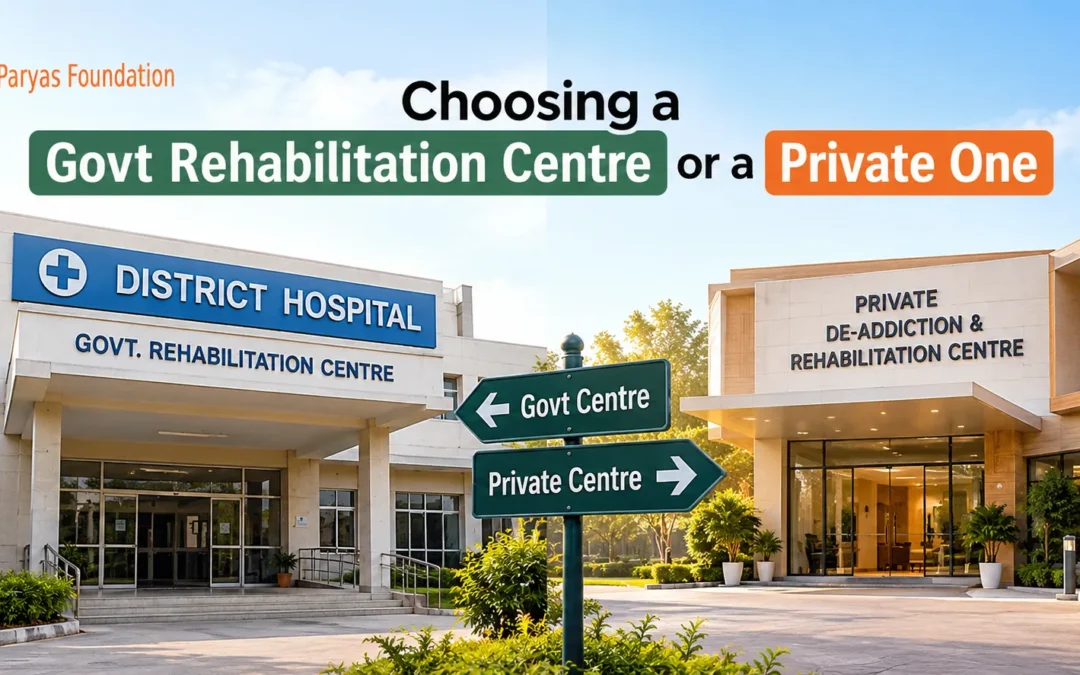
When a family is ready to act, the next question that usually comes up is “Government or private?”. “It depends” is the truthful response to this reasonable question. This guide compares a govt rehabilitation centre with a private one, side by side, so you can decide with clear eyes.
In this guide
- What a govt rehabilitation centre offers
- Side-by-side comparison
- Pros and cons
- Who each option suits
- How to find a centre near you
- Checking a private centre
- FAQs
What a Govt Rehabilitation Centre Offers
In Punjab, public services come in a few forms: district and medical-college hospitals, state-run de-addiction and rehabilitation centres, and outpatient opioid clinics (OOAT). Some NGO-run rehabilitation centres also receive funding under the Ministry of Social Justice and Empowerment’s National Action Plan for Drug Demand Reduction.
Detox and rehabilitation are two different stages. Detox clears the substance from the body under medical care. Rehabilitation is the longer work of counselling and rebuilding routines. Punjab’s 2011 regulations, as quoted by The Quint, say a person should have detox at a recognised centre before being admitted to a rehabilitation centre. Ask which stage a centre provides.
On cost, Punjab Health Department letters from 2018 set user charges at Rs 200 a day at government de-addiction centres and Rs 50 a day at government rehabilitation centres. Yellow or blue card holders and those living below the poverty level were to receive treatment at no cost. A later 2018 order said treatment would be at no charge for everyone at government and Indian Red Cross centres. These orders are several years old, so confirm what applies today. Our guide to a 🔗 free nasha mukti kendra explains how to check.
Side-by-Side Comparison
These are general patterns, not rules. Individual centres differ.
| Government centre | Private centre | |
| Cost | Low, and at no charge where you are eligible | Paid. Fees vary a lot between centres, so ask for a written, itemised quote |
| Admission | Can involve waiting, and beds may be limited | Often quicker |
| Medical cover | Linked to a hospital for emergencies | Varies. Find out if a doctor is available or on call. |
| Counselling time | Staff may be stretched across many patients | Can be more personal, depending on staffing |
| Comfort and privacy | Basic, often shared wards | Wider choice, including private rooms |
| Oversight | Run by the state | Must be registered. Quality varies, so check |
| Family involvement | Varies | Varies. Ask before admission |
Pros and Cons
Government centres
Pros
- Much lower cost, and sometimes none
- Connected to hospital services if something goes wrong
- A suitable fit when the primary obstacle is financial
Cons
- Beds and appointments can be limited
- Wards can be crowded, with less individual attention
- Facilities differ by district, and some centres may be inactive, so call ahead
Private centres
Pros
- Faster admission in many cases
- More options for rooms, schedules, and duration of programs
- Can offer more counselling time and family sessions
Cons
- Higher cost, and extra charges for medicines or tests
- Uneven quality. Punjab news reports over the years have described unregistered centres and poor practice at some facilities, though many run properly
- Harder to compare, because every centre prices differently
For a closer look at pricing, see our breakdown of the 🔗 cost of rehab in Punjab.
Who Each Option Suits
A government centre may suit you if cost is the biggest concern, the person is willing to wait for a bed, or you want care linked to a hospital. An outpatient opioid clinic can work well for someone who needs to keep working and can attend daily.
A private centre may suit you if you need admission quickly, want more privacy, or need a longer, more structured stay and can afford it.
A mix can work too. Some families use a government service for detox, then move to a private or NGO programme for rehabilitation, or the other way round. Ask the treating doctor what makes sense.
How to Find a Centre Near You
Searching for a government de-addiction centre near me online can show outdated listings. These steps are more reliable:
- Ask the Civil Surgeon’s office or the district hospital’s psychiatry department for the nearest working centre.
- For a referral, contact the national de-addiction hotline.
- Phone the centre before you travel. Verify that it is open, has beds, and accepts new patients.
If you are near Chandigarh, our page on a 🔗 nasha mukti kendra in Mohali lists what to ask locally.
Checking a Private Centre
If you are looking at a private nasha mukti kendra, check these before you pay anything:
- Registration and licence. Ask to see them.
- Doctors. Who is on site, and who handles an emergency at night?
- Assessment. A responsible centre assesses the person before quoting a plan.
- Total cost, in writing, with extras itemised and a receipt for every payment.
- Treatment of patients. Visit in person if you can. Ask about visiting rules, phone access and consent.
- No guarantees. Any center that offers a cure should be avoided.
FAQs
1. What is the work of a rehabilitation centre?
A rehabilitation centre provides structured treatment and support to help people recover from physical injuries, surgeries, mental health conditions, or substance use disorders. Its work may include medical care, therapy, counselling, physical rehabilitation, and aftercare to improve daily functioning and support long-term recovery and independence.
2. Do you pay for rehabilitation?
Rehabilitation may be free, subsidised, or paid, depending on the type of treatment, facility, and available financial support. In India, government hospitals and recognised de-addiction programmes may provide free or low-cost services, while private centres generally charge fees. Before admission, ask about the total cost, available government assistance, insurance coverage, and any additional charges.
3. How do I find a government de-addiction centre near me?
Contact your nearest government district hospital and ask for its psychiatry or de-addiction department. You can also approach the District Social Welfare Office or Civil Surgeon’s office for information about government-supported treatment facilities. Ask for a referral and call the centre beforehand to confirm its services, admission process, availability, and eligibility requirements.
4. What should I ask before choosing a private Nasha Mukti Kendra?
Before choosing a private Nasha Mukti Kendra, ask about its registration, qualified doctors, medical supervision, staff credentials, emergency arrangements, treatment methods, and family involvement. Confirm the complete treatment cost, including medicines and additional services, and ask what aftercare and relapse-prevention support are provided. Request clear written details and avoid centres that promise guaranteed recovery or cannot explain their treatment process.