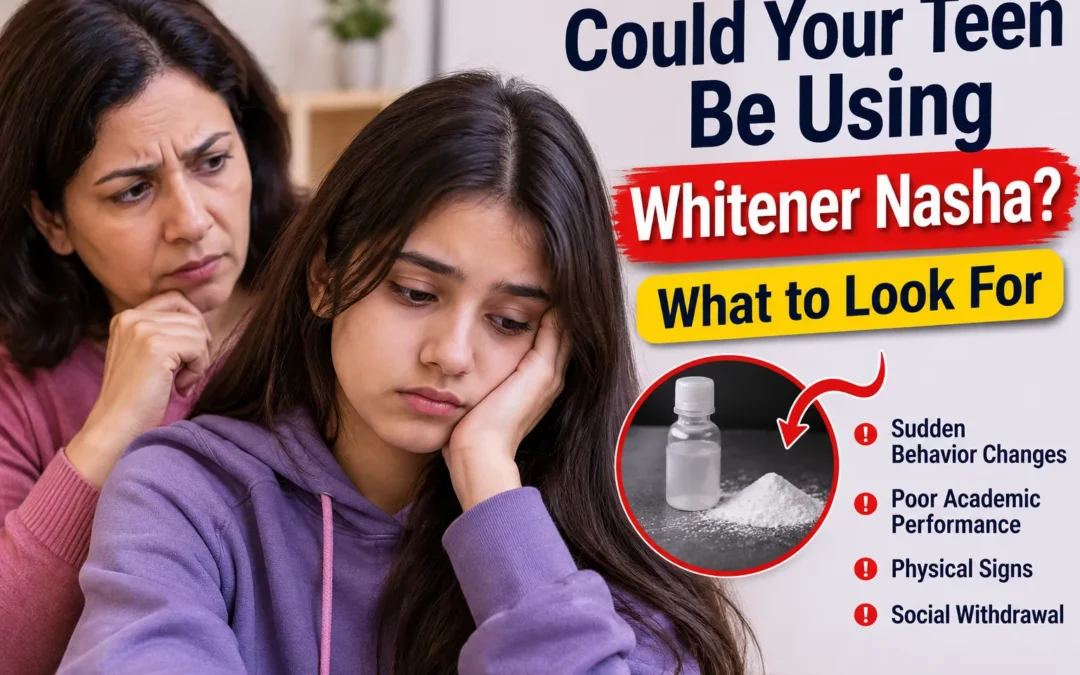
Short answer: Yes, a teenager can be at risk. Whitener nasha means breathing in the fumes of correction fluid, and it is one of the few substances that children use more than adults. Look for a chemical smell, stains, hidden bottles, dizziness and sudden changes in mood or marks. Stay calm, talk without blame, and see a doctor. In an emergency, call 112.
Perhaps a partially empty bottle was in your child’s school bag. Or maybe it was a particular odour or your child acting as though they were drunk during the school day (at 4pm no less). Either way, you’re here right now and you’re nervous.
Whilst I always begin by offering reassurance and indeed this is appropriate your child is not ‘astray’ simply because they have been asked this question. Indeed, the majority of families successfully manage this issue if it is identified at an early stage.
Why Whitener Nasha Spreads Among Teens
Correction fluid and similar products contain strong solvents. In whitener nasha, a young person breathes in the fumes for a short, light-headed feeling. The feeling doesn’t last, so some children go back for it.
It is also widely available. It is inexpensive and is even legal. Therefore a child could believe that it is not actually a drug. Further, it can be seen on all study desks. Adolescents will also imitate one another.
A national drug use survey has shown that 1.17% of children between the ages of 10 and 17 currently misuse inhalants. This is greater than adults’ figures for the same behaviour (0.58%). Inhalants are the only group of drugs which show this increased childhood usage. Approximately 0.21% of children also engage in either misuse or dependency. As outlined in a 2023 Cureus review, typical motivations for adolescent inhalant misuse include peer pressure, family issues, and educational pressures alongside good availability (Cureus, 2023).
However, this does not make your child ‘bad’. Indeed, both the goods and indeed young people themselves are highly accessible.
Warning Signs Parents Can Spot
No single sign proves anything. Look at the whole picture over a few weeks. Our fuller checklist is in the 🔗 nasha mukti guide.
What You May Notice on the Body
- Bad odour from the body, including breath, hair and clothing.
- Discolouration around the mouth, nose and/or hands.
- Bloodshot or watering eyes, a runny nose and/or mouth ulcers.
- A feeling of lightheadedness, poor coordination, and/or “drunk” behaviour (without the influence of alcohol).
- Headache and/or lethargy and/or reduced appetite.
What You May Notice Around the House
- Empty bottles, tubes or soaked cloths hidden in bags, drawers or rooms
- A lot more correction fluid or glue than schoolwork explains
What You May Notice in Behaviour
- Irritability, mood swings, or a sudden quiet
- Marks dropping, skipped classes, lost interest in friends and sports
- Secrecy, lying, long time spent alone
Many of these have other causes: stress, illness, or ordinary teenage change. Treat them as a reason to talk, not as proof.
Why It Needs Attention, Without Panic
Inhalants can also damage the brain, nervous system, heart, liver and kidneys. In some cases, doctors have stated that they can also lead to acute heart issues which may prove to be life threatening and even occur in someone’s first time of inhalant use.
Alongside this issue, Indian research, including research on children in the Northeast, has shown that experimenting with inhalants is associated with future drug-taking behaviour. Increased risk of heroin, alcohol and/or parenteral drug misuse is also noted in later issues in a 2022 Kolkata clinical paper. Many families refer to heroin as smack. Again, in its own right, smack addiction is a significant problem. Therefore, it is also crucial to identify and address this type of drug addiction in teenagers. Early intervention can then reduce the chances of an escalated issue.
How to Talk To Your Teen
This is usually the hardest part. A few things help.
Pick the moment. A quiet time. Not during an argument, and not when he seems unwell or “high”.
Start with care, not accusation. “I’m concerned because I’ve noticed that you seem exhausted lately.” opens a door. “What have you been doing?” closes it.
Ask, don’t assume. “Have you or your friends tried whitener or glue?” works better than “I know you’re using it.”
Skip the labels. Words like “addict” make teenagers hide. “You’re struggling” is kinder and truer.
Listen first. Let him talk, even if it is only a little.
Expect a no. Many teenagers deny it at first. Stay calm, and try again another day.
Punishment rarely helps. Fear makes children secretive, and secrecy is the biggest risk. If you want someone to help you plan the conversation, you can talk to our counselor before you speak to your child.
What To Do If You Suspect It
- Stay calm. If you find your child in the middle of it, avoid shouting or chasing. Move him to fresh air. If he seems unwell, faint or short of breath, call 112.
- See a doctor. A paediatrician, or the psychiatry department of a government hospital, can check his health and advise next steps.
- Speak to the school. A trusted teacher or counsellor can help you watch for changes.
- Plan treatment. There is no specific medicine for inhalant dependence. Treatment is mainly counselling, family support and care for any health effects, and for conditions like depression or anxiety if they are present. Recovery is possible, especially when it is caught early.
For free mental health support, you can call Tele-MANAS on 14416, or the national de-addiction helpline on 9988199333 for counselling and referral.
When to Seek Help Straight Away
Visit a hospital right away if your child:
- Has a seizure, chest discomfort, or difficulty breathing
- Collapses, faints or can’t be woken
- Is very confused or hallucinating
- Talks about harming himself
For anything less urgent, book a doctor’s visit within days, not weeks.
Preventing Whitener Nasha at Home
You can’t watch your child every minute. What you can do:
- Talk early and often. Explain that ordinary products can be harmful when misused, before there is a problem.
- Know what’s in the house. Keep strong solvents and paints out of children’s reach.
- Stay connected. Children who feel heard hide less.
- Watch the stress. Exams, bullying and tension at home can push children towards risky behaviour.
- Work with school. Ask whether your child’s school teaches about inhalants.
If Your Child Needs More Than a Doctor’s Visit
Some families need a specialist programme. If you are near Mohali, you can look at a nasha mukti kendra in Mohali. Before you choose any centre:
- Ask whether it treats children and teenagers, and how
- Check that it is registered, and ask to see the licence
- Ask who the doctors and counsellors are
- Get the total cost in writing
- Ask how families are involved
Phone before you travel. Many teenagers don’t need a residential stay, so ask what is actually suitable. Be careful with any 🔗 nasha mukti kendra that promises a guaranteed cure.
FAQs
1. What Is Whitener/Nasha?
Whitener is a commonly available correction fluid that contains volatile chemicals. Some people misuse it by inhaling its fumes to experience intoxicating effects. Repeated inhalation can lead to psychological and physical dependence.
2. Can Whitener/Nasha Be Harmful to Adolescents?
Yes. Inhaling whitener fumes can harm the brain, nervous system and other organs, particularly during adolescence. Even a single episode of inhalant misuse can cause serious, potentially life-threatening complications, including dangerous heart rhythm disturbances and sudden death.
3. How Can I Tell If My Teenager Is Inhaling Whitener?
Possible warning signs include a chemical smell on clothing or breath, discolouration around the lips or fingers, hidden containers or cloth used for inhalation, dizziness, behavioural changes and declining academic performance. However, no single sign confirms inhalant use. Talk openly with your teenager and seek an assessment from a qualified healthcare professional.
4. Is It Possible to Overcome Whitener Dependency?
Yes. Recovery from whitener dependency is possible with appropriate professional support. Treatment generally focuses on behavioural therapy, counselling, family involvement and addressing related physical or mental health concerns. Early identification and continued support can improve recovery outcomes.